
Summary
The Double Reverse Polish method of reconciling two balances requires a reconciled starting position. All transactions from each source are then considered unreconciled. A process of condensing identifies unique unreconciled items while maintaining the full reconciliation in balance.
Process
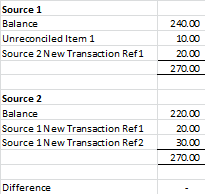
Starting with a balanced reconciliation, all new transaction from the first source are added to the reconciled balance of the second source. All new transactions from second source are added to the reconciled balance of the first source.
Because all transactions from both sources are considered unreconciled, the reconciliation continues to balance when all new transactions are added.
The reconciliation is then condensed by matching corresponding reconciling items. The reconciler can confirm the overall reconciliation remains in balance as items are matched.
The reconciler then verifies the validity of the remaining reconciling items to ensure a meaningful corrected reconciling balance is derived.
Requirements
The reconciliation should always clearly state:
- The un-adjusted balance from each source
- The corrections to each source
- A meaningful revised balance matching each source
- A Zero value difference between the reconciled sources
Practical use
The Double Reverse Polish method can reconcile any two sources. It is particularly used for large or complex reconciliations where matching transactions is problematic. Because the reconciliation remains in perpetual balance and captures information from all sources it represents a complete record of the sources. While it may assist in identifying matching transactions, it does not guarantee that all items are matched and so further condensing may be possible.
Care should still be taken to ensure the remaining reconciled items are valid adjustments to each source. The remaining adjusted and reconciled balance should be meaningful.
Example
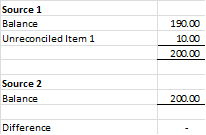
A balanced reconciliation is provided:
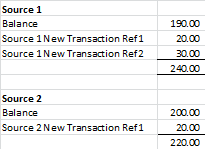
Each Source has new transactions:
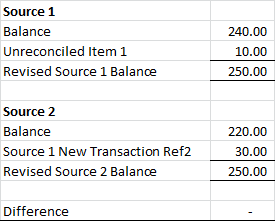
All new transactions are considered unreconciled and added to the original reconciliation:
Matching items are then condensed:
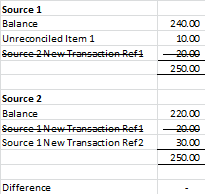
To give a final reconciliation:
Comments
0 comments
Please sign in to leave a comment.